
An exploration of Mohsin Hamid’s critique of American identity through the lens of economic imperialism and cultural assimilation
Introduction
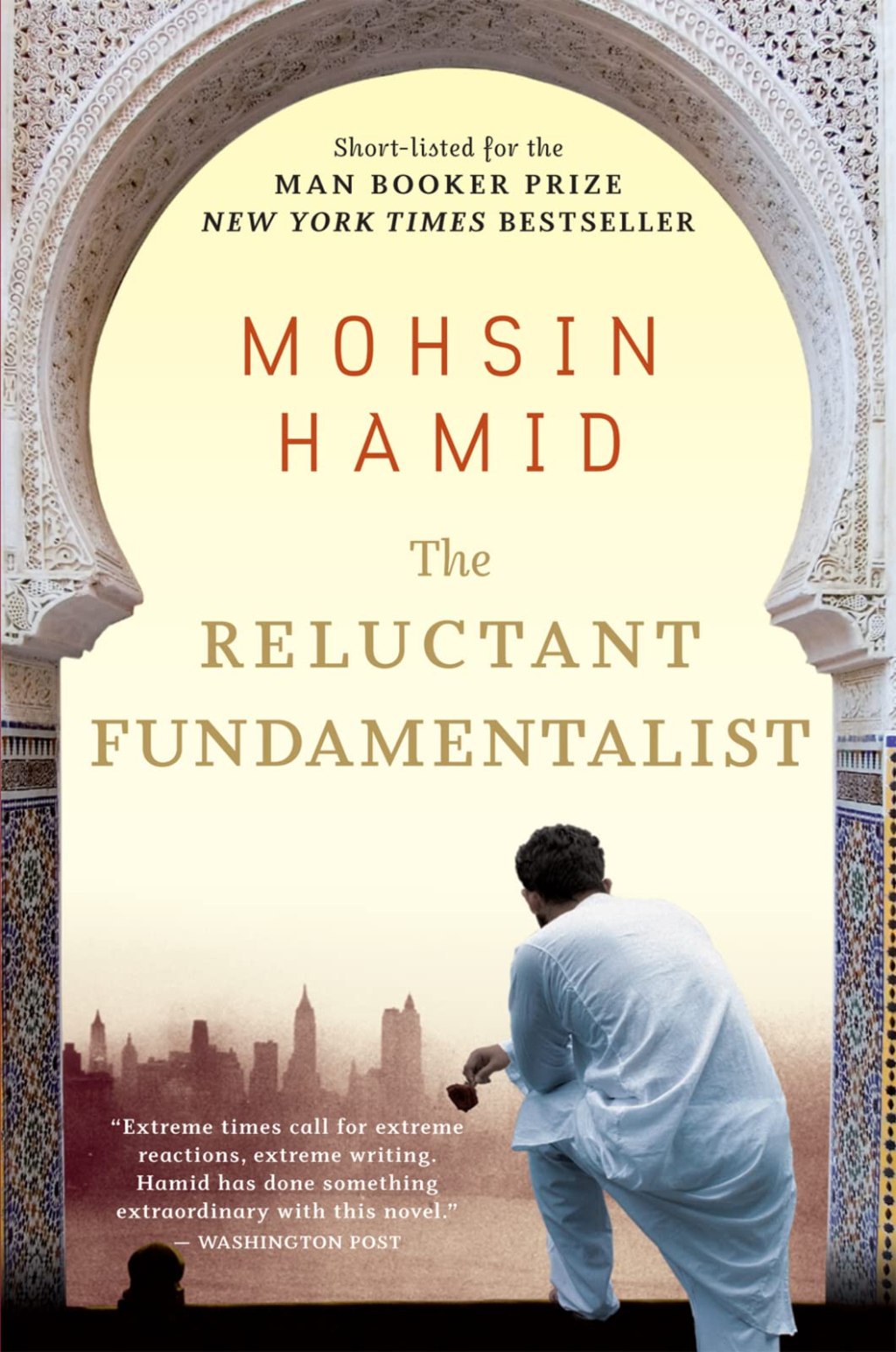
The idea of American identity is complex and filled with turmoil. One can argue identifying as “American” can involve speaking English, being born in the United States, embracing the culture, or simply participating in the capitalist market that fueled the country’s economic success. In the novel The Reluctant Fundamentalist, Mohsin Hamid does not view American identity as a distinct culture but as an absence of one. Hamid highlights that being American is not tethered to ethnicity or culture. Instead, it is about shedding one’s previous identity to conform to the dominant empire.
Background Context
The Reluctant Fundamentalist traces the journey of its protagonist, Changez, in a semi-bildungsroman style. A bildungsroman, defined in The Oxford Dictionary of Literary Terms, is a novel “That follows the development of the hero or heroine from childhood or adolescence into adulthood, through a troubled quest for identity.” (Baldick) While the novel does not directly delve into Changez’s childhood, it initiates his story during his college years, follows him through his career, and ultimately explores his return to Pakistan, hence why one could consider Changez’s story a semi-bildungsroman as it only traces a brief period of Changez’s life. The story captures Changez’s disconnection from his former self and his realization that he identifies more as Pakistani than American, embodying the quest for identity inherent in a bildungsroman.
The New York Paradox: Maintaining Identity in the Heart of Empire
Building on the theme of identity, the analysis delves into Changez’s experience as he navigates the cultural landscape of New York City. Changez resided in New York City when hired by the firm Underwood Samson. Despite spending four years in New York, he retained aspects of his identity. The presence of Urdu-speaking taxi drivers and a Pak-Punjab Deli in his neighborhood allowed him to maintain connections to his past as he navigated life in a new country. Changez explicitly states, “I was, in four and a half years never an American; I was immediately a New Yorker” (Hamid 33). The passage illustrates that even in the United States, particularly New York City, Changez held onto some elements of his identity through language and cuisine that reminded him of home.
However, there is a notable correlation between living in New York and being part of the American empire. Brewer’s Dictionary of Phrase and Fable discusses the connection between New York and the Empire, stating, “New York, the great commercial city of the USA, from its situation in the Empire State, the name given to New York State on account of its wealth and importance.” Changez is in the heart of the American Empire, New York City. New York City is a significant economic and populous hub in the United States. New York is also a diverse city, as Changez can still maintain some of his identity through food and language. This dynamic showcases that America’s identity is not solely defined by its culture but also by its role in production and influence. New York has many cultures but still maintains its role as an economic powerhouse for the U.S.
Finance as Imperial Power
Moving beyond cultural identity, exploration of the economic dimensions of America’s influence unfolds, as highlighted in Changez’s journey. The Oxford Companion to International Relations describes an empire as an “unbounded system of influence and rule” (Zielonka). Changez directly applies this term to the United States during his journey back from Chile, stating, “Finance was a primary form by which the American empire exercised its power” (Hamid 156). Changez’s statement emphasizes the connection between America being an empire and its predominant tool for expanding influence, finance. Changez’s claim contrasts with other empires that may rely on cultural influence or military force to spread their imperial reach.
Changez, a native of Pakistan, ventured to the United States for his education and later pursued a business career. The Princeton Encyclopedia defines this migration, often called brain drain, as “The emigration of skilled and professional workers (such as engineers, scientists, doctors, nurses, and university professors) from a country. These people emigrate legally, become residents or even citizens of a new country (the host or destination country), and stay there with no intention of returning to the source (sending) country” (Wong). The crucial aspect of this definition is that the brain drain victim does not return to the source/home but stays in the host country, in this case, the United States. Despite the prevalence of this system in many Western countries, Changez challenges the concept of brain drain. He reveals his reservations about this practice and, by the conclusion of the novel, decides to return to Pakistan permanently, divorcing himself from the pattern associated with brain drain.
America as System, Not Nation
Transitioning from the economic perspective, examining how the pursuit of wealth intertwines with the individual’s sense of self comes into focus. The concept of brain drain hints at the idea that American identity is devoid of a distinct identity, emphasizing profit and labor. Instead of intending to return to their home country, the skilled laborer essentially adopts the host country as their new home. In The Reluctant Fundamentalist, Changez reflects on this process, expressing, “Looking back now, I see the power of that system, pragmatic and effective, like so much else in America. We international students were sourced from around the globe, sifted not only by well-honed standardized tests but by painstakingly customized evaluations” (Hamid 4). The strict testing and selection process suggests how Changez perceives America as a system rather than a nation—a system lacking a specific identity, embodying an absence of identity.
Changez participates in America’s economic pursuits, leaving his home country to pursue the wealth that America promises to individuals worldwide. In this perspective, America becomes more of a system than a defined entity, reinforcing that its identity lies in its economic mechanisms rather than cultural or national characteristics.
The Underwood Samson Allegory
The connection between the economy and American identity is further highlighted. In a scene where Changez discusses his time at Underwood Samson, a firm focused on evaluating overseas business, it illuminates American identity. Changez remarks, “At Underwood Samson, creativity was not excised – but it ceded its primacy to efficiency. Maximum return was the maxim to which we returned, time and time again” (Hamid 37). The Underwood Samson training underscores the link between the economy and American identity. Additionally, in Roberta’s article (Mis)Reading in the Age of Terror: Promoting Racial Literacy through Counter-Colonial Narrative Resistance in the Post-9/11 Muslim Novel, they point out that “Underwood Samson (which, abbreviated, has the same initials as the United States).” (Wolfson 242) The Underwood Samson abbreviation suggests that Underwood Samson serves as an allegory for the United States, implying that it is a system prioritizing maximum return and profit over creativity and individuality.
In this allegory, Hamid suggests that Underwood Samson (representing the U.S.) is a system indifferent to creativity and individuality, focusing solely on maximizing returns. Changez’s statement further reinforces this notion: “On that day I did not think of myself as a Pakistani, but as an Underwood Samson trainee” (Hamid 34). Changez’s new “Underwood Samson trainee” identity highlights his act of shedding his past identity to conform to the values of Underwood Samson—a reflection of the broader idea that the U.S. is a system that molds individuals for economic efficiency.
The Fluidity of American Identity
Sandu’s article New Cold War Nostalgia in Recent U.S. Cultural Productions further explores perceiving America as a system rather than a fixed cultural entity. The article explains how America’s identity shifts based on its perceived threat, particularly in its historical relationship with the Soviet Union during the Cold War. Sandu notes, “American identity still dependent on a real and imaginary relationship with its former enemies, unwilling at this point to fully renounce the Cold War binary dynamic.” (Sandu 628) The article suggests that America’s identity is contingent on external factors, particularly its perceived threats, and it hesitates to let go of the Cold War mentality.
In the context of New Cold War Nostalgia in Recent U.S. Cultural Productions, this variable identity is portrayed in the media, emphasizing the dynamic relationship between America and the media. Moreover, it underscores that America’s identity is flexible but adaptable, changing based on its interests, particularly in profits and defense. The media reflects this fluid identity as it adapts to portray whoever/whatever is perceived as America’s current identity or threat.
The Making of Soldiers
A scene from The Reluctant Fundamentalist, where Changez observes his coworkers at Underwood Samson, underscores the link between media and America’s capacity to reshape its perceived identity and culture. Despite their initial diversity in terms of gender and origin, Changez realizes that after training in a system focused on “maximum returns” (Hamid 37), they all become virtually indistinguishable. He notes, “I must be honest, it strikes me now – that shorn hair and dressed in battle fatigues, we would have been virtually indistinguishable” (Hamid 38). Changez’s observation points out how Underwood Samson produces individuals devoid of distinct identities, akin to soldiers who become indistinguishable from one another.
Changez’s coworker Wainwright notices Changez’s realization and warns, “Beware of the dark side, young Skywalker” (Hamid 38), referring to Star Wars, a cultural giant in U.S. media. In this context, the “dark side” refers to surrendering one’s identity, a concept that Changez is beginning to recognize. This interaction illustrates the interplay between culture and America, as highlighted by Hamid in the novel. The Star Wars reference further emphasizes the influence of media in shaping perceptions and warning against losing one’s identity in the pursuit of conformity.
The Post-9/11 Awakening
Examining the aftermath of societal changes, there is an exploration of how external threats contribute to the fluidity of America’s identity. The transformation of American culture in response to perceived threats is vividly portrayed in the novel, particularly in the aftermath of the 9/11 attacks. Changez, being of Pakistani descent, becomes a victim of Islamophobia and persecution. Returning from Manila shortly after 9/11, he experiences a sense of detachment from America. He remarks, “When we arrived, I was separated from my team at immigration. They joined the queue for American citizens; I joined the one for foreigners” (Hamid 75). This alienation becomes pivotal for Changez, prompting him to reevaluate his connection to American society.
Changez’s rejection of American society became more pronounced during his time in New York after the attacks. He expresses, “Certainly, I wanted to believe; at least I wanted to not disbelieve with such intensity that I prevented myself as much as possible from making the obvious connection between the crumbling of the world around me and the impending destruction of my personal American dream” (Hamid 93). The dichotomy of Changez embracing his past while trying to integrate into a society that rejects him contributes to what he perceives as the world crumbling around him, ultimately shattering his American dream. The breaking of his reality highlights the profound impact of societal changes on an individual’s sense of belonging and identity.
The Janissary Revelation
Alghamdi delves into the division within Changez’s psyche as a direct consequence of the American system in their article Shifting Positions: Identity and Alterity in the Reluctant Fundamentalist. They suggest, “As a direct result, the reader is invited, at this stage of the monologue, to abandon any entrenched opinions regarding the morality (or lack thereof) of the American system” (Alghamdi 53). An interaction between Changez and a man named Juan-Bautista, a client of Changez during his time at Underwood Samson, exemplifies the concept of Changez working for a system that contradicts the values of his Pakistani identity. Juan-Bautista, a Chilean publisher, rejects Changez’s assistance, viewing Underwood Samson as the opposite of culture. The firm’s objective is to evaluate foreign media companies, potentially leading to their downfall and erasing a country’s cultural output. Bautista, recognizing Changez’s internal conflict since the events of 9/11, attempts to convey his perspective by introducing the concept of a Janissary.
A janissary was a historical practice in the Ottoman Empire where Christian boys were captured and trained to fight for the Muslim Ottomans. Juan-Bautista highlighted this historical context to illustrate that Changez, a foreign individual residing in the United States and working for a firm deeply embedded in the American economic empire, mirrors the role of a janissary for the American empire. In this comparison, Changez finds himself torn between his foreign status and involvement in a system contributing to the potential danger his home country faces due to U.S. interference.
The Product of a System
The conversation with Juan-Bautista, likened by Changez to lifting a veil (Hamid 157), triggers a significant realization. Changez rejects his current self, resigns from his job, and returns to Pakistan, which he now sees as his true home. At this moment, Changez declares, “I resolved to look about me with an ex- janissary’s gaze – with, that is to say, the analytical eyes of a product of Princeton and Underwood Samson” (Hamid 157). Changez’s introspection reflects how education and work have stripped him of his identity, reducing him to viewing himself as a product rather than a person. Having experienced brain drain and worked in the finance sector, Changez seeks to disassociate from these aspects and promptly return home to Lahore.
Conclusion: Reclaiming Identity Against Empire
The analysis concludes by examining how Changez’s journey culminates in a decisive rejection of assimilation and a reclamation of his true identity. Changez’s semi-bildungsroman, encompassing his college and career in finance, illuminates the empirical system projected by America to assert power and influence. Viewing himself as a product of these industries and perceiving his coworkers as interchangeable reflects a focus on wealth over individual identity. Experiencing the aftermath of the 9/11 disaster, Changez witnesses how swiftly the society he aspired to be a part of can turn against him. This fluidity in the American attitude also points to a lack of a fixed identity, a notion Changez hints at in conversations about the history of Pakistan.
Changez emphasizes the importance of history in shaping identity, highlighting the contrast between Pakistan’s ancient history and America’s relatively brief one. The analogy of Changez being a janissary underscores the dichotomy of working for an empire that is hostile toward its agents. The title, The Reluctant Fundamentalist, aligns with The Encyclopedia of Social Problems’ definition of fundamentalism as the “Strict adherence and maintenance of traditional perspectives in reaction against secularism and modernism” (Okafor). In the novel’s conclusion, Changez rejects the erasure of his identity and embraces his Pakistani heritage, an act of resistance against the American Empire’s attempt to dehumanize and assimilate him into the financial superpower portrayed by the U.S.
Works Cited
Alghamdi, Alaa. “Shifting Positions: Identity and Alterity in the Reluctant Fundamentalist.” IUP Journal of English Studies, vol. 8, no. 1, 2013, pp. 51–67.
Baldick, Chris. “Bildungsroman.” The Oxford Dictionary of Literary Terms. Oxford University Press, 2015. Oxford Reference.
Empire. (2018). In S. Dent (Ed.), Brewer’s Dictionary of Phrase and Fable. Chambers Harrap.
Hamid, Mohsin. The Reluctant Fundamentalist. Harper Perennial, 2007.
Okafor, G. M. “Fundamentalism”. In V. Parrillo (Author), Encyclopedia of Social Problems, 2008. Sage Publications.
Sandu, Oana Popescu. “New Cold War Nostalgia in Recent U.S. Cultural Productions: Retro and Irony in the Transnational Postsocialist World.” Comparative Literature Studies, vol. 59 no. 3, 2022, p. 612–630.
Wong, Kar-Yiu. “Brain Drain.” The Princeton Encyclopedia of the World Economy, edited by Kenneth A. Reinert and Ramkishen S. Rajan, 1st ed, Princeton University Press, 2010.
Wolfson, Roberta. “(Mis)Reading in the Age of Terror: Promoting Racial Literacy through Counter-Colonial Narrative Resistance in the Post-9/11 Muslim Novel.” College Literature, vol. 50 no. 2, 2023, p. 237–267.
Zielonka, Jan. “Empire.” The Oxford Companion to International Relations. Oxford University Press, 2014.
 Trager Bos
Leave a comment